Level 5, Area C: Officers' Halls
 |
| This map is released under terms of the CC BY-SA 4.0 license. |
Room 15: Briefing Room
This room has smooth, polished walls, with glowing fungus
globes that reveal hieroglyphic engravings of snake-men Myrmidons engaged in
battle. The centerpiece of the room is a
large, rectangular table crafted from dark, fungal “wood”, intricately carved
with serpentine patterns and symbols.
High-backed chairs surround the table, crafted with snake-like motifs
coiling around the legs and armrests.
The table radiates magic, and at the head (with the largest
chair to the north) are 10 bronze buttons in a recess under the lip of the
table. Pressing a button has a random
effect (1d20):
1.
A center compartment opens to reveal a crystal,
half-hemisphere. It projects an illusory
map of an unknown, underground wilderness (the Underwilds beyond the City of
the Snake-Men in Level 8.)
2.
A secret compartment opens near the head of the table. It has a gold, jeweled Myrmidon Commander's medallion
inside worth 700 gp.
3.
The carved, serpent-shaped glyphs on the table
illuminate in seemingly random patterns then stop.
Nothing else happens.
4.
A loud, gong-like sound reverberates through the
room and halls. Random encounters are
now 2-in-6, and for the next hour, monsters encountered (randomly or in rooms)
cannot only be surprised on a 1-in-6 chance.
5.
A section of the northwestern wall slides open,
revealing a hidden, spiral stairway to Level 6 (Room 15)
6.
A small, retractable needle pricks the finger of
the character that pressed the button; save against poison or become paralyzed
as a hold person spell.
7.
As result 1, but the map shows an approximately
50-60 mile radius around the Temple of the Snake Cult, including the city of
Alkastra and other major areas of human, and demihuman habitation.
8.
Colored lights embedded in the table's surface
flash rapidly, affecting those in close proximity. Treat as a color spray spell (see below.)
9.
A hidden panel on one side slides opens to reveal a small
coffer with 600 gp inside.
10.
The table emits a sudden, whining burst of sound. Everyone’s voice around the table is
amplified, and speaking triggers a random encounter check.
11.
The table disappears! It is actually invisible.
12.
A burst of confetti, colorful streamers, and
bioluminescent, fungal dust sticks to characters around the table. It affects their ability to surprise
opponents by 1-in-6, and any thieves have a -20% penalty to hide in shadows
until the material is washed off.
13.
As result 1, but the crystal projects an image of some
battle or event involving snake-men. Is
it historical, or in real-time?
14.
The table emits a thick cloud of sulfurous smoke
that fills the room, obscuring vision.
15.
A hidden drawer opens with scrolls inside
that discuss battle strategies and intelligence reports. One is a magic scroll with a fog cloud spell (see below.)
16.
The table plays a haunting melody with a sound
like a zither. The resonating sound triggers
a random encounter.
17.
As result 1, but the table projects an image of
the City of the Snake Men (Level 7.)
18.
Anyone near the table experiences a brief
sensation of time slowing down or speeding up (roll 1d6: odd – speeds up, even
– slows down.) Time spent in the room is
doubled (speed) or halved (slow.)
19.
A small, hidden compartment opens with a potion of enlarge (growth) inside.
20.
The table's surface becomes dark, mirror-like, and hazy. The distorted reflection reveals writhing
masses of snakes surrounding multiple eyes that pop in and out of view, with a large, central eye remaining constant. The characters not so much hear as feel an
impatient voice in their head in the Chaotic language demanding to know what they
want. This acts like a commune spell (with the Snake God!) However, there is a 2-in-6 chance an answer
is deliberately false, or a misdirection.
Color Spray
1st-level
magic-user spell
Range: 15-ft.
cone
Duration: instant
A dazzling array of flashing, colored light springs forth in
a 15-foot cone from the magic-user’s hand.
The cone affects up to 1d6 creatures in order of distance from the magic
user (nearest first.) Creatures with six
(6) or more levels or Hit Dice (HD) or higher than the magic-user are allowed a
saving throw. Similarly, the color spray’s effect varies depending on
the creature’s level or HD:
- HD or levels equal or higher than the magic-user: victim(s) falls unconscious for 1d4 rounds
- HD or levels lower than the magic-user: victim(s) becomes
blind for 1d4 rounds
- HD or levels higher by three (3) or more: victim(s) become stunned (unable
to act) for one (1) round
Blind or eyeless creatures are unaffected by this spell.
Fog Cloud
2nd-level
magic-user spell
Range: 30 feet
Duration: 4 rounds + 1 per level
The magic-user creates a 20-foot radius cloud of dense fog centered
anywhere within the range of the spell.
The cloud’s shape is semi-spherical and can spread around corners. The fog obscures all vision (including
infravision,) past two (2) feet.
The fog cloud lasts for the duration of the spell. However, strong breezes or winds of moderate
or greater speed (of least 10 miles per hour) can disperse it, lowering its
duration by half.
A heavy, fungal wood door to the northwest is carved with
intricate dragons with the appearance of winged serpents. A central dragon’s eye is a peep hole that
opens from inside the room. The door leads
to the War Room (Room 16) and is locked.
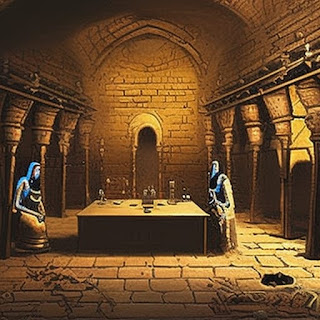 |
The Briefing Room table was built by the ennan and has unpredictable features (AI image courtesy of NightCafe.)
|
Room 16: War Room
The walls of this secure room are adorned with intricate
reliefs depicting snake-men Myrmidons at war.
In the center is a round, black granite table with maps and miniature
figures that symbolize military units or strategic assets. There are additional scrolls with maps and
military intelligence reports (in Chaotic script) on shelves in the north and
south walls.
Prominently displayed on the
northwestern wall is the battle standard
of the Myrmidons – coiled serpents encircling a central spear or polearm. The standard radiates magic. Once per day, the standard can be held
prominently aloft, or attached to a warrior’s back on a pole, and grants a
+1 bonus to attack rolls, morale, and saving throws against fear to all allies
in a 10-foot radius per level of the bearer.
The effect lasts for a number of rounds equal to the level of the
bearer, but it ends abruptly if the standard is lowered, the bearer falls prone, and/or drops it.
Changing the embroidered image on the standard
without destroying the enchantment requires an expert tailor specialized in
magical garments.
The door has a latch to lock it from the inside, making the
room a relatively safe place for player character’s (PCs) to rest and
recuperate.
Room 17: Meditation Room
The entrance to this room is through a sliding door decorated
with intertwined snakes and lotus blossoms.
The inside is bathed in a soft, ethereal glow emanating from a large,
bioluminescent fungus orb suspended from the ceiling which reflects on a pool
below, surrounded by low, wide cushions. The walls are adorned with tapestries of both
outer and underworld wilderness scenes.
There are three unique features to this room. First, the feeling of time is slightly
suspended in the room, so that every two turns spent inside is only one
outside. Second, the color of the light
in the orb changes depending on the mood of the majority of the people in the
room: anger (red,) fear (orange,) wonder/surprise (yellow,)
happiness/contentment (green,) sadness (blue,) anxiety (purple.)
Finally, anyone sitting on a cushion and concentrating can
make a Wisdom check. Success allows them
to communicate telepathically with another person that succeeded at Wisdom check. However,
every round spent conversing telepathically has a 1-in-6 chance that they will
be psychically overheard, triggering a random encounter.
Under one of the cushions is a neatly-folded robe made from
a large, silky snake skin. The serpent skin robe is magical and grants
the wearer a +1 bonus to Dexterity, and a +1 to saving throws against the
spells and abilities of snake-men, and other ophidian creatures (such as nagas or medusae; GM's discretion.) It also grants the ability to understand the
secret language of snakes (and snake-men) as a comprehend
languages spell.
Room 18: Myrmidon’s Arsenal
The door to this room is made of stone and locked (the
key is in Room 19.) This is where the snake-men
Myrmidons keep their personal weapons and other armaments for defending the
garrison. Inside are a series of racks
and display stands, showcasing an assortment of weapons and armor, some crafted
to fit the snake-men’s unique physiology: curved and sickle-shaped swords,
glaive and halberd-like polearms, and polished shields. There are a few other types of weapons, which
are used by the snake-men’s monstrous guards, such as the minotaurs in Room 8. A well-organized storage area houses spare
weapon parts, tools, and oil for maintenance and repair.
While the weapons and armor are well-made by ennan smiths,
most of them are mundane. However, there
is a 1-in-6 chance a unique magical weapon is currently stored here (roll 1d4):
1.
Fangblade:
this +1 short sword is made from the
entire fang of a giant serpent with carved, jagged edges and a scrimshawed
handle. The edge is alchemically treated
so that a wounded victim must save against poison or become weakened, suffering
a -1 penalty to hit and damage for 10 rounds (1 turn.) The alchemical poison currently has 17 uses
remaining.
2.
Snake
God’s Aegis: this round, +1 shield
is embossed in the image of the Snake God, with writhing serpents around a
central eye. When held, the shield grants a +1 bonus to save against spells and
poisons.
3.
Viperstrike
Glaive: the blade of this +1 polearm
is shaped like a striking snake. The
wielder of the glaive can attack a withdrawing enemy 3-5 feet away longer than
a polearm’s normal reach. The blade
animates into a snake that strikes for 1d6 damage. The victim must save against poison or become
slowed (as a reversed haste spell) for 1 turn (60 rounds.)
4.
Asp Knight's Rainment: this suit of +1 scale armor
is made from the hard scales of a giant asp.
Despite their hardness, the armor is quite supple and provides a +1 to
saving throws against poison and attacks or hazards that require agility to
dodge (GM’s discretion.) Additionally,
the wearer gains the ability to move silently (as a thief) with a 20% chance.
Room 19: Officers' Quarters
A winding passageway leads to apartments for the
snake-men Myrmidon officers. However,
the entrance is enchanted with an illusory trap. The south wall opposite of the entrance (“a”)
has a bas relief of the Snake God. If a character
does not walk backwards into the room (facing the Snake God) the passageway
continues as if entered from the beginning (“b”.) This creates the illusion of an infinite
passageway, giving snake-men defenders time to intercept invaders before they
reach the quarters. A clue to this trap
is in the poetry of Tsun-Tep in Room 14.
The room features a
common area with furniture such as low tables and divans to relax in, and
window openings to the northeast, which show the gardens behind base of the
True Temple below. To the west are
multiple apartments (“c”) with sliding doors.
Roll once on the following table for each apartment if searched (1d12):
1. An
ornate, serpent-headed spear in gold and gems is hung in the wall. It is worth
160 gp
2. Unlike
the bedding in the other apartments (flat, silken bedrolls,) this one has a luxurious
four-poster bed with intricately-carved serpentine designs, silken drapes, and soft
pillows. Under a pillow is a key to the Myrmidon's Arsenal (Room 18)
3. An
intricately-carved, serpentine pendant made of jade is hung on the wall above a
silk bedroll and worth 120 gp.
4. This
apartment has a well-crafted wooden desk adorned with serpentine motifs.
5. A
fine cloak with delicate silver embroidery in serpentine patterns is hung on a
peg. It is worth 80 gp
6. This
apartment features a small shrine dedicated to the Snake God, featuring an
intricately carved symbol of the deity and incense burners. The burners are made of silver with precious
stones and worth 100 gp each.
7. A
semi-concealed drawer under a small table has a pair of serpent-inlaid, bracers of defense (AC 7 [12].)
8. This
apartment has a glass display case with a collection of curious artifacts and
mementoes: an ancient, ceremonial bronze dagger, a carved stone serpent idol,
and a collection of large snake scales.
9. Under
the silken bedroll is a serpentbite ring
adorned with a coiled snake motif. Once
per day, a wearer can present the serpentbite
ring with a closed fist and speak a command word (engraved in the Chaotic
dialect of snake-men inside). This
causes the snake design to come to life and strike at an opponent for (attack as
a 2HD monster) for 1d4 damage. The
victim must and save against poison or suffer an additional 1d8 damage per
round for two rounds after a successful bite.
10. This
apartment features a reinforced case with a ceremonial sickle-sword,
finely-crafted shield, and a set of polished polearms.
11. A
set of ceremonial, bronze scale armor with precious, and semi-precious stones
is worth 180 gp
12. A
snake-skin tapestry displays a mesmerizing scene of snake-men Myrmidons in
battle. It is worth 130 gp to a
collector of exotic art.
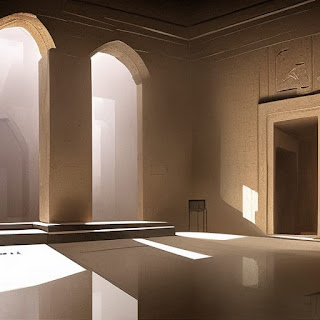 |
| The way to the Myrmidon's Quarters is trapped to become unreachable to assassins (AI image courtesy of NightCafe.) |
Room 20: Council Hall
This chamber is used for meetings and audiences between the
three castes of snake-men in the True Temple.
It features three levels to separate the attending snake-men by caste:
Nobles on the western dais, Myrmidons at the center, and Emissaries at the
base. The hall has a 30-foot, vaulted
ceiling, and is dimly lit by glowing fungal globes on the walls and braziers on
the dais. There are three banners
hanging in the western wall that represent the three castes plus one for the
Snake God over them. The sibilant sounds
of the snake-man dialect can be heard in the hallways leading into this
chamber.
Xa-Bis, a
snake-man Noble (HP 25, with snake
eyes, snake tongue, and ophidian lower limbs,) who is the current Lady
Seneschal of the Myrmidon Garrison, is holding audience. There are also three (3) Myrmidons (HP 25, ophidian lower limbs, thick scales; 27,
distendable jaws and fangs, venomous blood; 27, extendable hood, snake tongue;
swords and shields,) and two (2) Emissaries
(HP 23, snake pheromones; 18, snake arms) present, with five (5) normal human (1-in-6 demihuman) servants
about.
The Lady Seneschal despises her
current position, which she considers beneath her, but she was on the losing
side of intrigues between Nobles vying for the favor of the Snake God. She is currently seeking ways to return to
the halls of power in the Palace of the Nobles (Level 6) below, perhaps by uncovering treason among the Myrmidons (such as Thet-Zuh’s desire to ascend to the
Noble caste.)
 |
| The Lady Seneschal is eager to reascend to her previous position (adapted from AI images courtesy of NightCafe.) |
Room 21: Archive
This octagonal room has three levels of book and scroll
shelves approximately 35 feet high, with stairs connecting each level. The books and scrolls are written in the
Chaotic script of the snake-men dialect.
Roll on the following table for the contents of a book or scroll (1d20):
1.
The Serpentine Codex: An archive of the snake-men
castes and genetic variants, complete with anatomical drawings, and
documentation of their behaviors and esoteric qualities; heavily biased from a
Noble’s perspective.
2.
The Art of
Myconic Alchemy: A collection of botanical knowledge about mushrooms of the
Underwilds, their properties, and their practical applications.
3.
The Book
of Tau-Lat: not really a spellbook, but a textbook on basic, sorcerous
knowledge practiced by the snake-men.
PCs can learn about the basic spells the three castes of snake-men can
cast.
4.
Python’s Wisdom
- The Way of the Oracle: an ancient scroll describing the prophetic visions
and divinatory practices associated with the Oracles; written in the form of snake-themed
parables.
5.
The Slithering
Labyrinth: The classical snake-men
guide to deception and intrigue. Required reading for all castes, but especially used by Emissaries in the world above.
6.
Serpent's
Tongue - The Book of Speaking: A “rosetta stone” detailing the snake-men
language, its Chaotic script, and similarities to the languages of dragons and
lizardmen. A PC could learn the
snake-men language with this over time, but humans and demihumans tend to lack
the vocal anatomy to communicate with snakes.
7.
Ascendancy:
A pseudo-scholarly treatise on the snake-men’s history in 42 volumes. It is largely snake-supremacist fiction.
8.
The Book
of Vipers: A compendium of venomous snakes from around the world, detailing
their habitats, habits, and the unique properties of their venoms.
9.
The
Balanced Scale: A textbook covering the fundamentals of flesh-crafting.
10.
The Ouroboros
Spiral: A cryptic tome detailing the arcane theories of chronomancy.
11.
Testament
of the Eye: The main, religious text
of the snake-men and their Snake God.
Passages from it may be recognizable to those who have read the unholy
works of the Snake Cult.
12.
The
Serpent's Maze: A mystical book of logic and arcane puzzles designed to
test and enhance the snake-men’s problem-solving skills and magical aptitude.
13.
The
Eternal Cycle: The “old testament” holy book of the snake-men, focused on
their serpentine aspect of Tiama’at.
This book is old and dusty, as if it has not been touched for a long
time.
14.
The Scrolls
of Ka-do-Xa: An ancient healing and medical manual of the snake-men. Considered essential reading for
novice flesh-crafters before they are ready to move on to The Balanced Scale.
15.
Time of
Fang and Venom: The seminal snake-men manual on war strategy and tactics.
16. The Myrmidon Seven: Stories about the seven great Champions of the Myrmidon snake-men. It mentions the practice of petitioning them for fortune in battle (a clue to the statues in Room 22.)
17. Scroll with an architectural schematic of Level
4
18. Scroll with an architectural schematic of Level
5
19.
Scroll with an unlabeled map of the City of the
Snake-Men (Level 7)
20.
Scroll with an incomplete map of the Underwilds in
the vicinity of the City of the Snake-Men (Level 8)
The bookcase on the lower western wall can open to reveal a
secret passage that leads to another secret door beside the Meditation Room
(17.)
This work includes material taken from the
System Reference Document 5.1 (“SRD 5.1”) by Wizards of the Coast LLC and
available at https://dnd.wizards.com/resources/systems-reference-document. The SRD
5.1 is licensed under the Creative Commons Attribution 4.0 International License
available at https://creativecommons.org/licenses/by/4.0/legalcode.