Sunday, July 2, 2023

Dungeon23: Week 26

Level 5, Area B: Myrmidon Training


This map is released under terms of the  CC BY-SA 4.0 license.

Room 8: Sentry Hall

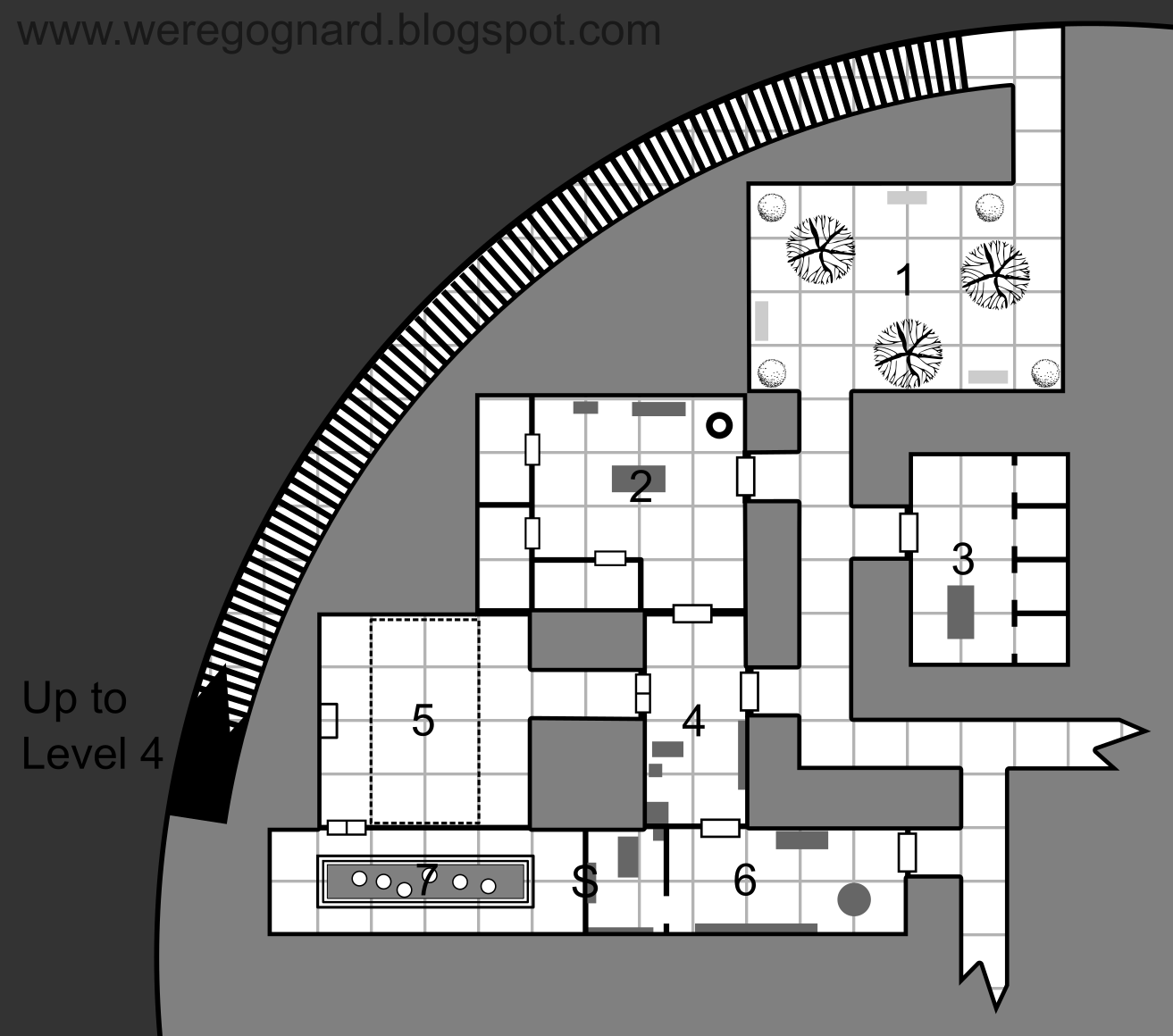
This hallway ends in a room (“a”) with carved windows, larger than arrowslits, which look out on the City of the Snake-Men (Level 7.)  The city is a great deal more visible here than from the haze of the Observation Deck (Level 4, Room 25) above. There is one (1) minotaur guard (HP 33, spear and shield) here and another (HP 34, polearm) at the entrance (“b”) to the Gestation Chambers (Area A.)  Since this sentry has his back turned to those exiting from the area, he is surprised on a 3-in-6 chance.  However, the other minotaur in the sentry box may hear signs of a struggle and investigate.  He only has a 2-in-6 chance due to noise from the Armory in Room 3.


Room 9: Training Courtyard

Double doors open to a wide courtyard where the young snake-men of the Myrmidon caste train.  The chamber has a central, rough area surrounded by slightly-raised perimeter.  There are weapon racks full of blunted, training weapons (-2 to damage.) Four sets of sliding doors lead out of the courtyard to other rooms in this area.


Room 10: Forge and Armory

This chamber is dim except for the light of hot coals, and heating metal in a stone forge carved in the likeness of a coiled serpent.  There are five (5) ennan (deep fey) here (HP 10, 10, 11, 12, 8) working on various projects.  This group serves the snake-men, making and maintain their weapons, armor, and complex, mechanical devices in the True Temple.  The ennan are so focused on their work that they are indifferent to anyone entering, unless they disturb their labors or try to steal from the armory.  In this case, they become hostile and employ several ingenious and cruel weapons against intruders: serrated short swords and hand axes that cause horrific wounds (damage takes twice as long to heal naturally,) hooked spears that can trip opponents (save against paralysis to avoid,) and mechanical, self-feeding crossbows that can fire every round without reloading. 

Do not disturb the ennan (AI image courtesy of NightCafe.)


Behind a barred area with locked door are racks of metal weapons and armor.  The lock is of a bizarre combination type, and requires that a stuck panel be opened (strong, ennan hands can do this easily) to reveal an image of the Snake God embossed on metal tiles around a central eye button.  However, the snakes around the eye are out of alignment. To align them, the opener has to slide and turn the tiled sections around the eye.  A successful Intelligence check can reveal the next step of the combination.  Refer to the diagram and list for the solution:


1.       Slide “A” up two times.

2.       Slide “B” down twice.

3.       Slide “C” left

4.       Slide “D” right

5.       Turn “B” to the left

6.       Turn “A” to the right

Each time a tile is placed or turned in the correct position, it settles with an audible click.  After the last one is placed correctly, the central eye can be pressed to open the lock.  The ennan smiths with 12 and 11 HP (the master and his journeyman) know the combination.  A thief can try to disable the lock’s mechanism and open it with a roll at -20% due to the unusual construction.

Although all the arms and armor here are finely crafted, three pieces have special qualities: a well-balanced spear provides a +1 bonus to hit (melee and thrown,) a razor-sharp sickle-sword deals 1d8+1 damage, and a cuirass (plate mail) of a strange, crimson metal weighs half as much as other armor of its type (or counts as lighter armor for encumbrance purposes.)  In addition, a small coffer on the table has 130 gp and a gold necklace with a stylized hammer design in semi-precious gems worth 40 gp.

The forge shares an exhaust vent with the kitchen hearth, and is wide enough for small characters to access (see Room 12.)


Room 11: Proving Ground

This cavernous room is dim and hazy with the light of bioluminescent fungus.  It is similar to the Emissaries’ Meditation Garden in Level 4, Room 20, but it has been arranged as a dense, maze-like forest of underwild foliage.  This is a deadly obstacle course for training young Myrmidon snake-men.

The dense, myconic vegetation reduces characters’ move and visibility by half.  Furthermore, there are several dangers present to test a Myrmidon’s resilience and combat ability:

a.       A bulbous growth extends spear-like thorns in all directions when it detects heat within five feet.  Victims must save against paralysis to avoid 1d6+2 damage.

b.      A trip rope activates a swinging masses of dense, fungal “wood” that smash anything between them for 4d6 damage (save against breath to avoid.)

c.       An area covered with vine-like growths have razor-thin filaments that protrude from them.  Victims walking through suffer 2d6 damage (save against wands for half.)

d.      The area in front of a pond with a waterfall (fed from the stream in the Emissaries’ Meditation Garden) conceals a 10-foot pit trap with small spikes (save against breath to avoid.)  The spikes deal 1d4 damage in addition to the fall damage.

In addition to the hazards, there are five (5) eunshiel (deep fey) assassins (HP 8, 5, 5, 2, 2) lurking about.  The assassins serve the snake-men, and this area serves for their training as well, with failure usually resulting in death.  They will stalk intruders (hide in shadows 20%, move silently 20%, and backstab as thieves) and will attack at a time of their choosing, such as when the characters encounter a trap, hazard, or are otherwise distracted.  They prefer hit-and-run attacks, attempting to melt back into the foliage the round after attacking.
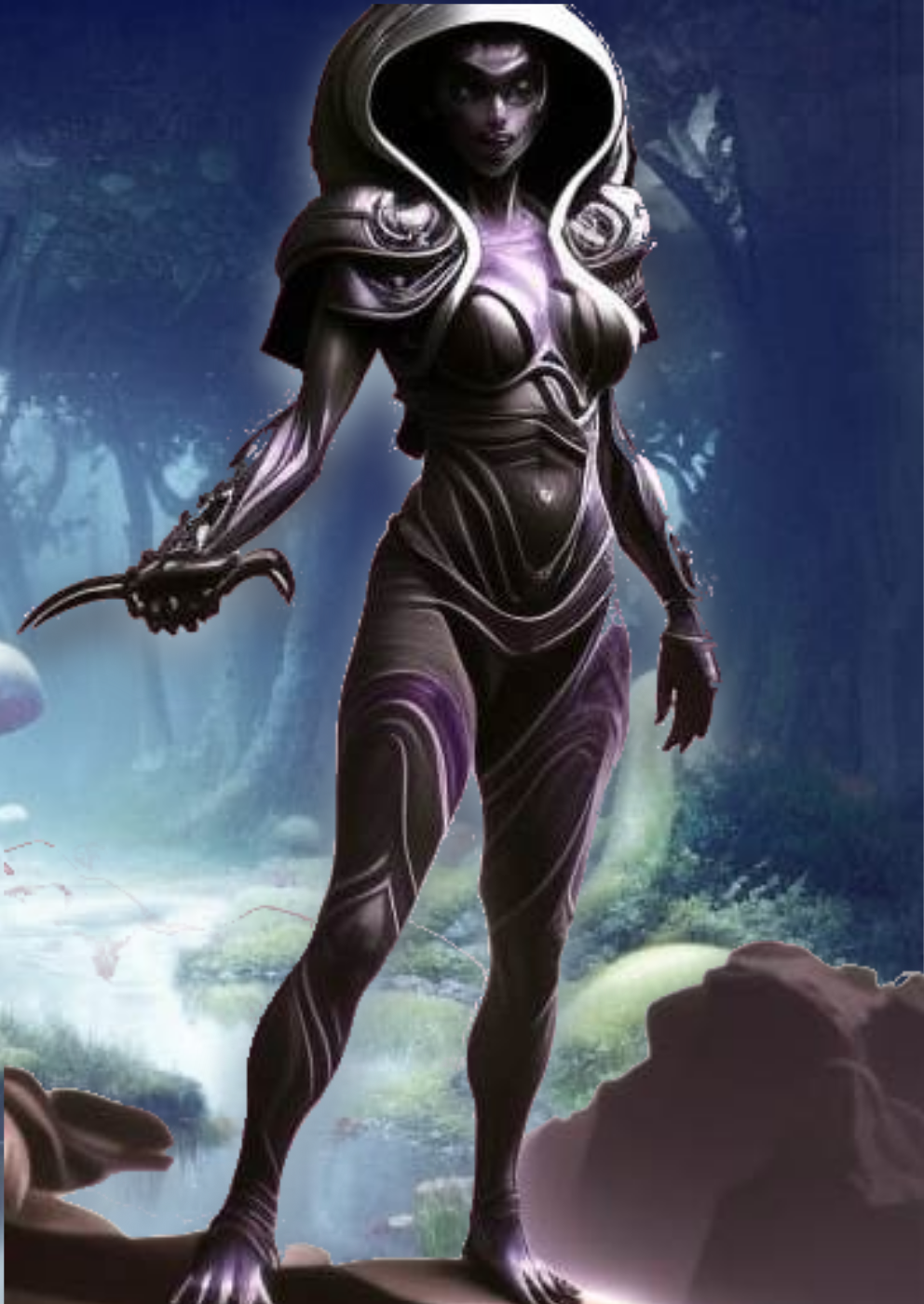
This "garden" is more deadly than relaxing (adapted from AI images courtesy of NightCafe.)


The exit hall has stairs that lead to the bottom area of the Warmaster’s Pit (Room 13,) and a secret door on the eastern wall leads to Area D (Room # TBD.)


Room 12: Gathering Hall

This hall features low tables where the Myrmidons in training take their meals. An area in the rear is a kitchen where 1d4 normal human servants butcher and prepare the snake-men’s food – a constant reminder of their own possible fate if they displease their masters.  The servants will cower before any player characters (PCs), but there is a 1-in-6 chance one will have enough courage to assist them.

The hearth shares an exhaust vent with the forge in the Armory (Room 10.)  It is roughly three feet in diameter and small characters can crawl through to gain access to the adjacent room.  However, if one or both fires are active, the smoke inside the vent is a suffocation danger for anyone inside.


Room 13: Warmaster’s Pit

This chamber has an upper gallery, with an entrance to the north, and a combat pit 10 feet below, which can be entered from the south (past Room 11.) The chamber is lit by torches and braziers.

There are two (2) snake-men Myrmidons (HP 16, extendable hood and thick scales; 21 advanced venomous blood; swords and shields) fighting in the pit, under the stern gaze of Tsun-Tep, the Myrmidon’s Warmaster, above.  Tsun-Tep (HP 31, ophidian lower limbs, distendable jaws and fangs) is an advanced combatant and fights with long, and short sickle swords (1d8 and 1d6 damage) in lieu of a shield.  He can make twin attacks with these.  If both hit against a single opponent, he locks their weapon and gets an additional bite attack.  He can also forego all attacks and trip an opponent with a lower limb attack on a successful hit (save against paralysis to avoid.)

Tsun-Tep and Thet-Zuh (see Level 4, Room 15) are clutch-brothers and have a lifelong rivalry (with Thet-Zuh typically the loser.)  In fact, if the PCs are in the Overseer's employ, he would surely delight in seeing his rival brought low.

Tsun-Tep is the Myrmidon's implacable Warmaster, and Thet-Zuh's bitter rival. (AI image courtesy of NightCafe.)


Room 14: Barracks

This hall-like room has ten (10) silk bedrolls placed neatly along the sides, each below a glowing fungus globe with a small foot locker near.  This is where young Myrmidons-in-training sleep.  At the end of the hall is a sliding door that separates the Warmaster’s room from the others.

The lockers have small, personal effects, some which may be valuable, such as simple jewelry.  Such items are worth 3d6 gp each (one per locker.)

The Warmaster’s room is spartan, with a bedroll to the side, a low table with papyrus-like fungus sheets, ink, pen, and a glowing fungus globe, as well as a large chest with his personal effects. 

On the wall above the chest is a torso mannequin wearing a suit of lacquered scale armor.  The arms hold a two-handed sickle sword in the ready position.  Anyone opening the chest activates a mechanized trap that causes the sword to slice up, down, and diagonally repeatedly and with great speed for 2d10 damage (save against breath to avoid.)  The mechanism stops if the chest is closed.  A hidden switch on the mannequin (under the armor) deactivates the trap.

Inside the chest is a bag with 950 sp and a +2 shield of protection from energy (resist cold.)  There is also a collection of scrolls, written in Chaotic, which discuss snake-men battle tactics, fighting techniques, and even poetry with religious ("To the Snake God's gaze riven, the back is never given.  Obeisance clears the way.",) grotesque, and snake-supremacist themes.  One scroll has magic spells: knock, protection from evil (10’ radius), polymorph (others,) minor illusion (ventriloquism,) and reversed knock (wizard lock.)


This work includes material taken from the System Reference Document 5.1 (“SRD 5.1”) by Wizards of the Coast LLC and available at https://dnd.wizards.com/resources/systems-reference-document. The SRD 5.1 is licensed under the Creative Commons Attribution 4.0 International License available at https://creativecommons.org/licenses/by/4.0/legalcode.

Wednesday, June 28, 2023

Dungeon23 (Bonus): The Deep Fey of the Underwilds

Deep Fey

Ennan (left) and eunshiel (right) deep fey (adapted from AI images courtesy of Bing Image Creator.)


Eunshiel

Armor Class (AC): 4

Hit Dice (HD): 1+1

Move (MV): 120 ft. (40 ft.)

Attack (ATK): 1 weapon (1d6+1 short sword, or 1d4+1 winged knife)

# Encountered (#): 2d4 (4d10)

Save (SV): Elf 1

Morale (ML): 7-9

Treasure (TR): E-type or by HD

Alignment (AL): Chaotic

Experience (XP): 60 (or HD + two specials)


Ennan

Armor Class (AC): 4

Hit Dice (HD): 2

Move: 60 ft.  (20 ft.)

Attack (ATK): 1d6+1 (hand axe or short sword) or 1d6 (crossbow)

# Encountered (#): 1d4 (3d10)

Save (SV): Dwarf 1

Morale (ML): 8

Treasure (TR): G-type or by HD

Alignment: Neutral or Chaotic

Experience (XP): 60 or (HD + one special)


Deep fey share common ancestors with demihumans and other surface fey.  Whereas the surface fey rebelled from servitude to the dragons, the clans that would one day become the deep fey remained loyal.  As the rebelling fey hunted their draconic masters, the ancestors of the deep fey sought to defend them, creating a centuries-long enmity with their cousins.  Alas, the surface fey succeeded in their rebellion, and their civilizations ascended to great heights while the deep fey fled to shelter underground; either following their fleeing masters or as refugees after these dragons were slain.  The deep fey have changed and adapted throughout the centuries to life in the unique and dangerous environment of the Underwilds.

Eunshiel

The Eunshiel (OON-shayl) are ancestors of modern-day elves and halflings.  They are slightly shorter than surface elves and much thinner, with delicate features, and pale, violet-tinged skin and hair (from a lifelong diet of violet shrieker mushrooms.)  Their ears are long and slender, and their eyes dark and near pupilless; well-suited to the lightless environment of the underwilds (90-ft. darkvision,) but bright light bothers them (-1 to hit.)

Eunshiel warriors are harnessed in arms and armor crafted by the ennan.  Their form-fitting chainmail functions as +1 armor, but it is far too slender to fit even surface elves.  They carry scalpel-sharp, short swords that have a +1 bonus to damage, but are difficult to wield without extensive training (non-eunshiel using these can cut themselves accidentally on an attack roll of “1”.)  They also carry throwing knives with a winged, draconic design that they are able to throw with extraordinary accuracy.  Once per combat, an eunshiel that surprises an enemy may throw a winged knife and strike unerringly as a magic missile spell (1d6+1 damage.)  For every five HD, an eunshiel may throw an additional winged knife simultaneously.  Eunshiel like to coat these winged knives in myconic poisons native to the Underwilds.

All eunshiel have sorcerous training and can typically cast darkness or sleep once per day.  A favorite tactic is to envelop enemies in magical darkness and slay them with their winged knives.

The example above is the typical eunshiel warrior or scout.  Other eunshiel may have additional HD, abilities, or spells of unique or greater power.

The eunshiel worship Tiama’at the Many-Faced and serve all Chaotic dragons.  Their art, architecture, and clothing tend to have draconic motifs.  Despite their Chaotic nature, they pride themselves in remaining loyal to the dragons, and hate the surface fey and demihumans with fanatical passion.

The eunshiel live bizarre lives of cruelty and decadence, enjoying bizarre and depraved pastimes when they are not busy serving their masters' needs.  They are subservient and obsequious with dragons, and snake-men, but consider all other beings beneath them, even their fellow deep fey.  They are deeply jealous of the snake-men’s favored status with their dragon goddess, but bite their tongue when around them.  They believe the snake-men have turned from Tiama’at and if they could but prove it and slay their aberrant Snake God, it might be their chance to elevate their status and take over the snake-men’s cities as their own.

In the Underwilds, the eunshiel are found in bands that hunt and patrol the domain near dragon’s lairs.  For every 20 eunshiel encountered, there is a leader with 2d4 HD, additional spells and possibly magic items usable by elves.  Eunshiel fighting alongside their leader have morale scores of 9.

Ennan

The Ennan (EH-nahn) are evolutionary ancestors of dwarves and gnomes.  They are almost completely hairless save for tufts on their head and/or short beards, with pale gray skin tones like the underground stone, and large ears.  Like their cousins, the eunshiel, their eyes are large and dark, and can see well in the dark (90-ft. darkvision,) but also suffer -1 to hit in bright light.

The ennan are masters of toil and creation.  They can work for hours on end without exhaustion.  Their idea of a good time is to engage in crafts such as smithing, stone-carving, or engineering with singular focus.  Indeed, their labors are greatly prized by the denizens of the Underworld.  Although hard-pressed to do so, the snake-men would grudgingly admit that their magnificent cities would not be possible without the ennan’s expertise.

While the ennan are not as passionately hateful as the eunshiel, their crafts have a penchant for the sinister: exotic weapons, mechanized siege engines, intricate traps, and sadistic torture devices.  Ennan don’t mind their lower status among the other beings of the Underworld: their work is all that matters.  However, some younger ones have begun to question their subservience to the eunshiel, dragons, and snake-men.  They wonder whether their distant cousins above had the right of it, and whether they should leave these ungrateful masters behind to pursue their work unmolested.

In combat, the ennan’s work-hardened strength and endurance make them fearsome foes (+1 damage.)  In addition, their weapons tend to have ingenious features.  For example, their shields may have spikes or blades that grant them an additional, 1d4 damage attack, an axe or sword may a have a serrated edge that causes terrible wounds, which take twice as long to heal, or a crossbow might fire two, or even three bolts at the same time.

For every 15 enann, there is a leader with additional 1d4+1 HD, which may possess better armor (AC 2 [17]) and/or magic items.  Enann fighting alongside their leaders have a morale of 10.


This work includes material taken from the System Reference Document 5.1 (“SRD 5.1”) by Wizards of the Coast LLC and available at https://dnd.wizards.com/resources/systems-reference-document. The SRD 5.1 is licensed under the Creative Commons Attribution 4.0 International License available at https://creativecommons.org/licenses/by/4.0/legalcode.

Sunday, June 25, 2023

Dungeon 23: Week 25

Level 5, Area A: Gestation Chambers


This map is released under terms of the  CC BY-SA 4.0 license.

Level 5 Features

Light: Most of the rooms here are lit by colored glass globes with bio-luminescent fungus inside, similarly to Level 4.  Other types of light (or lack thereof) will be noted in the room description.

Walls: Rooms and corridors are generally 10-15 feet tall and the walls are made of carved or worked stone within the rock formation.  Taller rooms are noted in their individual descriptions.

Doors: Most doors are made of the same fungal “wood” as some doors in Level 4.  A few are sliding doors with a fungal wood frame and semi-opaque screens that have a papyrus-like consistency.  Many of these are decorated with serpentine hieroglyphs. Any locked doors are noted in the room description.


Room 1: Courtyard

This chamber is a garden-like courtyard.  Unlike the Emissaries’ meditation garden (Level 4, Room 20,) this area is stone-worked, with exotic, rain forest trees, flowering shrubs on planters, and stone benches to sit in.  The environment appears to be magically controlled to allow for the growth of these surface plants.  The area is meant for the recreation of snake-men young, as well as the pregnant flesh stock that bear them.

Two of the trees are the home of giant constrictor snakes (rock pythons, HP 20 each.)  They are instinctually protective of the snake-men young, and have been trained to not harm the pregnant flesh stock.

There is a 1-in-6 chance one of the Nursemaids (see Room 2) is here with 1d4 snake-men young and/or pregnant “bearers” (normal human females, 50% chance of each.)


Room 2: Nursery

This room has three sub rooms for snake-men young: one for recently-born infants, and two separate for Emissary and Myrmidon toddlers, as caste segregation begins early.  Snake-men young are not kept here past their toddler years.  When they come of age, they are sent to respective education centers in the City of the Snake-Men (Level 7.)  They then train for serve with members of their own caste.

In addition to the rooms, there is nursery furniture, a small table for meals, and a cook fire with a pot in the northeast corner.  There are large, rolled up mats placed aside where the guardian Nursemaids sleep.  They care and prepare meals for the both the young and the pregnant bearers in Room 3. 

The Nursemaids look like large, female humans (8-10 feet tall) with exaggerated features such as long arms or large ears – a sort of missing link between ogres and giants.  They are extremely protective of their charges and will fight to the death with incredible Strength (18) which helps in their duties as guardians and keeping the pregnant bearers in line.   In combat, they employ large knives, cleavers, or mallets, which they can hurl with great force (+3 to damage, 30-ft. range)

Nursemaids: AC 4 [15]; HD 5+3 (HP 28, 31); MV 180 ft. (60 ft.); ATK 1d6+3 (weapon); SV fighter 5; ML 12; AL N; XP 400 (or HD + one special)

The behemoth Nursemaids are gentle with their charges and fearsome with those who would harm them (adapted from AI images courtesy of Night Cafe.)
 

The Nursemaids have keys to Room 3.  Inside some of the cabinets are children’s toys such as caved figures, balls, rattles, and blocks.  Some of these (2d6) are made with precious metals and gems and are quite valuable (2d10x50 gp each.)  The valuable ones are only given to the Myrmidon young to imprint their caste distinction.


Room 3: Bearer Cells

This locked room is nevertheless peaceful and luxuriant, similarly to Room 7 in Level 4.  This is where the snake-men keep pregnant flesh stock during their gestation period.  The main room features comfortable couches and a table for meals.  The individual cells have bedding that is equally comfortable.  The women live a routine of comfort, nutritious food, regular exercise in the Courtyard, and frequent visits by the snake-men flesh-crafters to monitor their progress and perform the necessary, alchemical treatments to ensure healthy, snake-men offspring.

There are currently three (3) normal human women of child-bearing age in various stages of pregnancy.  The eldest, Engelise, is currently on her second pregnancy, and was recently placed in charge of the other two after her predecessor was “retired to a place of honor,” after the birth of a Noble (as far as the snake-men told her.)  The horrible reality is that the snake-men use flesh-stock “bearers” until they die in childbirth or are no longer deemed suitable (too aged, or after a stillbirth, for example,) then sacrificed.  The bearer of a Noble meets a similar fate (see below.)

The room has a cord with a warning bell that summons the Nursemaids in Room 2 – typically used to alert them to an imminent birth.  Regardless of reaction, there is a 5-in-6 chance one of them will use the bell at the earliest opportunity due to their high level of obedience programming.


Room 4: Birthing Chamber

This area is equipped with everything necessary for the flesh stock bearers to give birth to the snake-men young, such as beds, basins, clean cloths, and surgical tools.  When the time comes, they are brought here by the Nursemaids, and the Oracle is summoned from the door to the south (Room 6) to oversee the procedure and bear witness.  75% of the births are snake-men Emissaries, and 20% are Myrmidons.  They are both taken to the Nursery (Room 2) in the door to the north.  About 1% are stillborn, which results in the bearer being rejected for future use (if she survives) and taken back to Level 4 for sacrifice.

4% of the time, the bearer gives birth to a leathery egg instead.  This is an auspicious occasion for the snake-me, since it means a Noble will be born.  The Oracle, who labors to predict this moment, takes careful possession of the egg and removes it to the Sanctorium (Room 5) along with the mother, who is never heard from again.


Room 5: Sanctorium of the Exalted

This room is where the snake-man Noble eggs are taken for consecration.  The room is bisected by a pool of greenish, slimy liquid, and features an altar at the opposite end.  The pool is actually an illusion, which conceals a shaft that drops 80 feet to Level 6.  (Room # TBD.)  The bottom of the pit has multiple, long spikes.  Anyone falling into the pit (save against breath at -1 to avoid) will be pierced by 1d4 spikes for 1d6+2 damage in addition to damage from the fall.

The altar is plain, but features ornate, sacrificial cutting implements, a ritual bowl, and a gong for summoning the Nobles below, who levitate up the shaft and through the illusion to witness the consecration of one of their own (this symbolically mirrors the birth of snake-men Nobles in Room 7.)  The mother is then sacrificed and the egg bathed in her collected blood on the bowl.  Her lifeless body is then tossed into the shaft and the egg is taken to the Hatchery (Room 7.)  They only use a Noble’s bearer once, and while this seems counterintuitive, the snake-men’s caste-based hierarchy depends on careful control of their population.  The disposal of the mother and her blood is deliberate to thwart their use in illegal caste ascension.

The sacrificial tools have golden, jeweled handles and are worth 600 gp as a set (of six.)  The bowl is also gilded and jeweled, worth 1,200 gp.  The altar has two pieces of jewelry that a previous sacrifice wore: gold earrings with blue topaz worth 1,200 gp, and a silver lariat necklace that also dangles with blue topazes and is worth 1,000 gp.


Room 6: Oracle's Chamber

These are the personal chambers and study of the Oracle, who is unique among the snake-men.  Once in a generation, a snake-man is born which defies caste classification: an Emissary in appearance, a Myrmidon in physical prowess, and a Noble in sorcerous talent.  The Oracle is always born blind, but possesses the divinatory power to predict the births of Nobles with a high degree of accuracy.  This reason alone is why an Oracle is not immediately destroyed upon birth.

The current Oracle, Hap-Me is getting older, but at the height of her power.  She spends most of her time in these chambers, studying signs, portents, and the prophetic works of previous Oracles.  There are also a two (2) Emissary assistants (HP 22, snake arms; 16, thick scales) and a Myrmidon (HP 20, snake tongue, ophidian lower limbs, polearm) guard present.

The Oracle: AC 6 [13]; HD 5 (HP 26); MV 120 ft. (40 ft.); ATK 1d6+1 (sword stick); SP: advanced snake tongue/heat-sensing pits (1-in-6 surprise, detect invisible 30-ft.,) spells; SV elf 5; ML 8; AL C; XP 800 (or HD + three specials)

The Oracle holds a unique position in snake-men society (adapted from AI image courtesy of Night Cafe.)


The Oracle can cast spells as a Noble (once per day each): (cause) fear, darkness, levitate, polymorph (others,) animal friendship (snake charm,) and (transmute) sticks to snakes.  In combat, she relies on her Myrmidon bodyguard and Emissaries, and uses her spells to support them. She will engage anyone attempting to flank her with her ophidian detection abilities, and her walking stick, which is a hidden short sword.

The room has multiple books, scrolls, and charts used by the Oracle in her work.  A strange orrery on a table shows celestial or multiversal bodies in a combination heliocentric and sephiral model.  The parts themselves are made precious metals and gems.  The charts are worth 1,100 gp to a sage, or seer such as Zirhan the Astrologer in Alkastra, and the orrery is worth 1,300 gp.

The back bedroom, which is separated by a curtain, contains a chest with the Oracle’s ceremonial regalia: A thick, gold necklace with an image of the Snake God in black opals, and tourmalines worth 1,400 gp, and a gold diadem with peridots and carnelians worth 1,000 gp.

A secret door on the western wall of this room leads to the Hatchery (Room 7)


Room 7: Egg Hatchery

This is where the snake-men Noble eggs are incubated.  The eggs (1d6+1 in number) soak in a long pool of fluid which looks like the illusion in the Sanctorium (Room 5.)  This is no mere glamer, however.  It is the Ichor of Naph-et: a combination alchemical substance and ooze-like colony organism that provides the ideal environment for the eggs to incubate.

Snake-men Noble eggs incubating in their ideal environment (AI image courtesy of Night Cafe.)


To anyone other than snake-men Nobles or the Oracle, the Ichor acts like both a contact and inhaled poison.  Every round of exposure to the pool (inside or on the edge,) even with clothing since the liquid exudes an acrid miasma, requires a saving throw against poison.  Failure causes a loss of 3d6 Constitution, as the organisms in the Ichor and its miasma begin to dissolve and feed on organic matter.  A victim reduced to 0 Constitution dies, and is slowly consumed by the Ichor in a similar manner to green slime.  Those who survive regain lost Constitution at a rate of one (1) point per day of rest.

Bottom of Form

Top of Form


This work includes material taken from the System Reference Document 5.1 (“SRD 5.1”) by Wizards of the Coast LLC and available at https://dnd.wizards.com/resources/systems-reference-document. The SRD 5.1 is licensed under the Creative Commons Attribution 4.0 International License available at https://creativecommons.org/licenses/by/4.0/legalcode.

Year Two (or How to Sink a Blog)

  TL/DR: Year Two was the lesser, but still fun sequel to Year One. Happy New Year, and welcome to 2025! Been a while, huh? I don’t know how...